Their insurer refused every ransomware claim — MFA was started, not finished.
City of Hamilton · Ontario · February 2024. Ransomware cost the City of Hamilton $18.3 million in recovery. Its insurer refused every claim — about $5 million — because multi-factor authentication had been started but not finished, and the policy said started doesn't count.
What happened
Identified in the record as Reports CM25008 and CM24005(b) to Hamilton City Council.
Multi-factor authentication, started but not finished
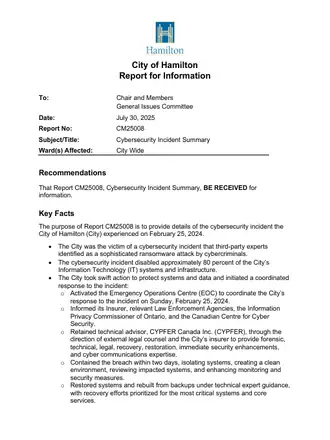 City of Hamilton report Read the original →
 In February 2024, cybercriminals gained access to an external internet-facing system at the City of Hamilton, deployed ransomware, and demanded a ransom. The way in was not email — it was a system facing the internet.
The attack disabled roughly 80 per cent of the city’s network, and the attackers wanted to be paid for the way out.
“The attackers demanded a ransom of roughly $18.5 million in exchange for a decryption tool to unscramble the city’s data.”
Recovery was long and expensive. By June 30, 2025, the City had spent $18.3 million on immediate response, system recovery and third-party expert support. It held cyber insurance, and it filed a claim.
“The insurer cited policy exclusions related to multi-factor authentication (MFA), noting that MFA had not been fully implemented at the time of the cybersecurity incident.”
The requirement was not news. Staff knew about the multi-factor authentication condition in the City's insurance policy in the fall of 2022, and a pilot rollout began the following year — but only for a few departments. When the attack came, the rollout had not reached everyone, and the policy gave no coverage for losses where the absence of MFA was the root cause.
“There was insufficient assurance prior to the incident that the cyber insurance policy would be applied as anticipated by the City.”
After the denial, the accountability question moved to council — who knew, and when.
“The city had full knowledge we were not compliant with the exclusion in 2023”
A third-party legal review confirmed the denial, and the City did not pursue it further — though it has since renewed its coverage. Its acting chief information officer disputed the insurer's finding, telling reporters the breach would have happened even with MFA in place. The dispute changed nothing: the exclusion was applied, and none of the roughly $5 million in claims was paid.
The rule that applied — in Ontario
The policy exclusion — the City’s own cyber insurance contract
“According to the policy, no coverage was available under the policy for any losses where the absence of MFA was the root cause of a cyber breach.”
The part that matters
A partial rollout was worth exactly the same as no rollout. The requirement had been known for over a year and a pilot had started — and because it had not reached everyone, the exclusion applied and the coverage was gone.
The transferable lesson is the policy exclusion, not the size of the loss. An exclusion applies to whoever holds the policy, and every Canadian cyber application form we have read asks about multi-factor authentication before quoting. The scale does not transfer: this is a municipality with an IT estate far larger than any firm we work with.
The documents
We hold dated copies — ask and we will send you what we read.
| Document | Our copy |
|---|---|
| Report CM25008 (the denial) | Copy held 2026-08-20 |
| Report CM24005(b) (the cost) | Copy held 2026-08-20 |
| Auditor General review | Copy held 2026-08-20 |
| City news release | Copy held, taken 2026-08-20 |
| CBC News (the $5M, and the council meeting) | Copy held 2026-08-20 |
| Global News, July 2025 | Copy held 2026-08-20 |
| CHCH News, October 2025 | Copy held 2026-08-20 |
The City's acting chief information officer told reporters the attack would have succeeded even with MFA in place. That dispute is worth knowing and it does not change the outcome — the exclusion was applied, the review upheld it, and the money was not paid.
Would the same exclusion apply to you?
No cost, no obligation — you keep the findings either way.
Get your free Security Snapshot